Deep Learning AI is a type of artificial intelligence that helps computers learn from data, just like humans do. It uses layers of neural networks to recognize patterns, make predictions, and solve complex problems. From self-driving cars to voice assistants, deep learning AI is becoming a part of everyday life and is changing the way we interact with technology.
What is Deep Learning?
Deep learning is a part of artificial intelligence (AI) that teaches computers to learn from examples, just like humans do. Instead of following fixed rules, deep learning uses neural networks with many layers to find patterns in data. It helps computers recognize images, understand speech, translate languages, and even play games. Deep learning allows machines to think and improve on their own using data.
How Deep Learning AI Works
Deep learning AI works by teaching computers to learn from data and improve their performance over time.
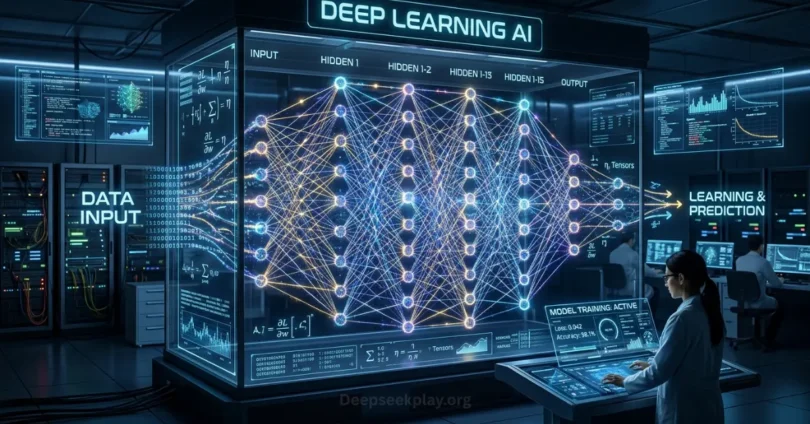
- Input Data: Computers start by receiving large amounts of data, such as images, text, or sounds.
- Neural Networks: Data is processed through layers of artificial neurons that mimic the human brain.
- Hidden Layers: These layers analyze patterns and features in the data step by step.
- Activation Functions: Decide which signals should pass forward to the next layer.
- Training: The AI adjusts its connections to reduce errors and improve accuracy.
- Prediction: After learning, the AI can make decisions, recognize patterns, or predict outcomes.
- Feedback Loop: Continuous learning helps the AI improve with new data over time.
Deep learning AI works by learning patterns from data and improving itself automatically.
Types of Deep Learning Models
Deep learning uses different models to solve various problems in smart ways.
- Convolutional Neural Networks (CNNs): Best for analyzing images and videos, like recognizing faces or objects.
- Recurrent Neural Networks (RNNs): Good for understanding sequences, such as text, speech, or time-series data.
- Generative Adversarial Networks (GANs): Create new data by learning patterns, like generating realistic images or art.
- Autoencoders: Learn to compress and reconstruct data, useful in image denoising and feature extraction.
- Deep Belief Networks (DBNs): Stack multiple layers to learn complex features from large datasets.
Different deep learning models are designed for specific tasks, helping AI solve problems efficiently.
Training Deep Learning AI
Training is the process where deep learning AI learns from data to make accurate predictions and decisions. This step is very important because the better the training, the smarter the AI becomes.
- Collecting Data: Large and high-quality datasets are gathered, such as images, text, or sensor data.
- Data Preparation: Data is cleaned, labeled, and sometimes normalized to help the AI learn effectively.
- Splitting Data: Data is divided into training set (to teach the AI) and testing set (to check accuracy).
- Forward Pass: Data passes through the neural network, and the AI makes an initial prediction.
- Calculating Error: The difference between the AI’s prediction and the actual result is measured.
- Backpropagation: The AI adjusts the weights in the neural network to reduce errors.
- Optimization: Optimizers like SGD or Adam help the AI improve learning speed and accuracy.
- Iteration: The AI repeats the process many times until it reaches high accuracy.
- Evaluation: After training, the AI is tested on new data to ensure it can generalize well.
Training deep learning AI is all about teaching it with data step by step so it can make smart and accurate decisions on its own.
Applications of Deep Learning AI
Deep learning AI is used in many areas to make tasks faster, smarter, and more accurate. It helps computers solve real-world problems that are difficult for humans to do manually.
- Image and Video Recognition: AI can identify objects, faces, or actions in photos and videos.
- Speech Recognition: Converts spoken language into text, used in voice assistants like Siri or Alexa.
- Natural Language Processing (NLP): Helps AI understand and respond to human language, used in chatbots and translation tools.
- Self-Driving Cars: AI analyzes sensor and camera data to navigate roads safely.
- Healthcare: Detects diseases from medical images, predicts patient risks, and assists in diagnosis.
- Finance: Detects fraud, predicts stock trends, and helps in risk management.
- Entertainment: Suggests movies, music, and content based on user preferences.
- Robotics: Helps robots perform tasks like picking objects, cleaning, or assembling products.
- Gaming: AI creates smarter opponents and enhances gaming experiences.
Deep learning AI is transforming many industries by making processes faster, smarter, and more efficient. Its applications are growing every day.
Tools and Frameworks for Deep Learning AI
Deep learning AI requires special tools and frameworks to build, train, and test models efficiently. These tools make it easier for developers to create smart AI systems without starting from scratch.
1. TensorFlow
- Developed by Google, it is widely used for building neural networks.
- Supports large-scale AI projects and has tools for training and deploying models.
2. PyTorch
- Developed by Facebook, popular for research and flexible model building.
- Easy to debug and allows dynamic changes while training models.
3. Keras
- A high-level interface that works on top of TensorFlow.
- Simple to use for beginners to create neural networks quickly.
4. Caffe
- Focused on image processing tasks.
- Fast and suitable for deep learning in computer vision.
5. MXNet
- Lightweight and scalable, used for cloud-based AI applications.
6. OpenCV
- Specialized in image and video processing.
- Often combined with deep learning frameworks for real-time applications.
Using the right tools and frameworks makes building, training, and deploying deep learning AI models faster, easier, and more effective.
What is the Difference Between Machine Learning and Deep Learning?
Machine learning and deep learning are both parts of artificial intelligence (AI), but they work in different ways. Understanding their differences helps to know when to use each one.
1. Data Dependency
- Machine learning can work well with smaller datasets.
- Deep learning requires large amounts of data to perform accurately.
2. Feature Extraction
- Machine learning needs humans to select important features from data.
- Deep learning automatically finds patterns and features without human help.
3. Complexity
- Machine learning models are simpler and faster to train.
- Deep learning models are more complex and need high computing power.
4. Performance
- Machine learning works well for simpler tasks like predicting prices or classifying emails.
- Deep learning excels in complex tasks like image recognition, speech understanding, and self-driving cars.
5. Hardware Requirements
- Machine learning can run on regular computers.
- Deep learning often needs GPUs or specialized hardware for fast training.
Machine learning is good for simpler tasks with less data, while deep learning is best for complex problems and large datasets, learning patterns automatically.
Future of Deep Learning AI
The future of deep learning AI looks bright and exciting. It will continue to change how we live, work, and interact with technology.
- Healthcare Innovation: AI will help doctors detect diseases faster and design personalized treatments.
- Self-Driving Technology: Cars and drones will become safer and more reliable with advanced AI.
- Smart Cities: AI will manage traffic, energy, and resources efficiently for better urban living.
- Robotics: Robots will perform complex tasks in homes, factories, and hospitals.
- Natural Language Understanding: AI will communicate more naturally, making chatbots and assistants smarter.
- Education: Personalized learning with AI will help students learn at their own pace.
- Ethical AI: Focus on making AI safe, unbiased, and fair for everyone.
- AI in Creativity: AI will assist in creating art, music, movies, and even writing.
Deep learning AI will continue to grow, making technology smarter and more helpful in everyday life while opening new opportunities for innovation.
Common FAQs About Deep Learning AI
Here are some faqs of Deep Learning AI.
What is the main goal of deep learning AI?
Deep learning AI aims to make machines learn from data and improve automatically without explicit programming.
Can deep learning AI learn on its own?
Yes, deep learning AI can improve itself by analyzing new data over time, which is called self-learning.
Which industries benefit most from deep learning AI?
Industries like healthcare, finance, transportation, robotics, and entertainment use deep learning AI for better decision-making.
Is deep learning AI the same as neural networks?
Neural networks are the building blocks of deep learning AI, but deep learning involves multiple layers and complex architectures.
How long does it take to train a deep learning AI model?
It depends on data size and model complexity. Some models take hours, while others require days or weeks.
Can small businesses use deep learning AI?
Yes, with cloud services and pre-built models, even small businesses can implement AI solutions without huge hardware costs.
Does deep learning AI require programming skills?
Basic understanding of programming helps, but many user-friendly frameworks like Keras and TensorFlow simplify the process.
What makes deep learning different from traditional AI?
Traditional AI uses rules and logic, while deep learning learns patterns and features directly from data.
Are there risks associated with deep learning AI?
Yes, risks include biased data, overfitting, and ethical concerns, but careful design and monitoring reduce them.
How will deep learning AI change the future?
It will automate complex tasks, improve decision-making, enhance healthcare, education, robotics, and make everyday technology smarter.
Conclusion
Deep Learning AI is transforming the way computers learn and solve problems. By analyzing large amounts of data, it can recognize patterns, make predictions, and improve itself over time. From healthcare and finance to self-driving cars and entertainment, deep learning AI is shaping the future of technology. Learning and using it responsibly can open endless opportunities for innovation and smarter solutions.