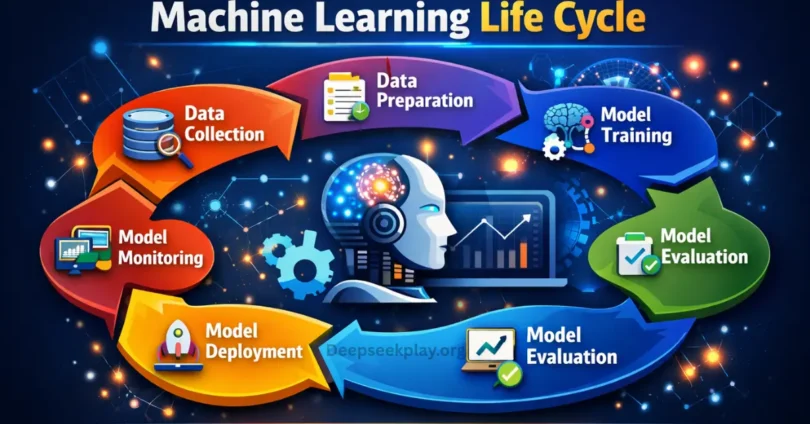
Machine Learning Life Cycle is the process of creating and using machine learning models step by step. It helps in solving real-world problems by using data. Each step, from collecting data to deploying the model, is important to make sure the results are accurate and useful.
Problem Definition
The first step in the Machine Learning Life Cycle is to clearly define the problem. Without knowing the problem, it is impossible to find the right solution.
- Understand the problem: Ask what you want to solve. For example, predicting house prices or detecting spam emails.
- Set goals: Decide what you want the model to achieve. The goal should be clear and measurable.
- Identify problem type:
- Classification: When the result is a category, like “spam” or “not spam.”
- Regression: When the result is a number, like predicting temperature or price.
- Clustering: When you want to group similar items, like customer types.
A clear problem definition helps in choosing the right data, model, and evaluation method for your machine learning project.
You May also Visit this Link: Artificial Intelligence Basics PPT
Data Collection
Collecting the right data is the first step to train a machine learning model. Good data gives better results.
- Sources of Data:
- Databases and spreadsheets
- Online websites and APIs
- Sensors and IoT devices
- Public datasets available for research
- Types of Data:
- Structured data: Organized in rows and columns, like Excel sheets
- Unstructured data: Text, images, videos, and audio files
- Data Quality:
- Ensure data is accurate and complete
- Avoid duplicates or missing information
- Check for consistent formats
- Data Storage Tools:
- SQL and NoSQL databases
- Cloud storage platforms like AWS, Google Cloud
Collecting clean and relevant data is key to building a successful machine learning model.
Data Cleaning and Preparation
Preparing data correctly ensures the machine learning model works accurately.
- Remove missing values: Delete or fill incomplete data entries.
- Fix incorrect data: Correct typos, errors, or wrong entries.
- Remove duplicates: Ensure each record is unique.
- Convert formats: Standardize data types and units.
- Normalize data: Scale data values for uniformity.
- Feature selection: Choose important features for the model.
- Encode categorical data: Convert text labels into numbers.
- Handle outliers: Identify and correct unusual data points.
- Split data: Divide data into training and testing sets.
- Document changes: Keep a record of all cleaning steps.
Clean and well-prepared data is the foundation of an accurate machine learning model.
You May also Visit this Link: Juwai Morning Teer Result Arcarrierpoint
Exploratory Data Analysis (EDA)
Exploratory Data Analysis (EDA) is the process of understanding your data before building a model. It helps find patterns, trends, and important features in the data.
- Understand Data Patterns: Look at how data values are distributed and identify common trends.
- Visualize Data: Use charts, graphs, and plots to see relationships clearly. Examples:
- Bar charts for categories
- Line charts for trends over time
- Scatter plots for relationships between features
- Identify Correlations: Find which features affect each other or the target variable.
- Detect Outliers: Look for unusual data points that may affect model performance.
- Summarize Statistics: Check mean, median, mode, and standard deviation for numeric data.
- Feature Insights: Decide which features are important for predicting results.
EDA helps in understanding the data clearly and guides the next steps in building an effective machine learning model.
Choosing the Right Model
Choosing the right machine learning model is important to get accurate results. The model must match the problem type and data characteristics.
- Types of Machine Learning Models:
- Supervised Learning: Learns from labeled data (e.g., predicting house prices).
- Unsupervised Learning: Finds patterns in unlabeled data (e.g., grouping customers).
- Reinforcement Learning: Learns by trial and error using rewards (e.g., game AI).
- Match Model to Problem:
- Use classification models for categories (spam or not spam).
- Use regression models for numbers (predicting temperature).
- Use clustering models for grouping similar data (customer segments).
- Considerations While Choosing Model:
- Accuracy: How well the model predicts results.
- Speed: How fast the model trains and predicts.
- Complexity: Simpler models are easier to understand and maintain.
- Data Size: Some models need more data than others.
- Trial and Testing:
- Test different models on a small sample of data.
- Compare performance using evaluation metrics.
Choosing the right model ensures better predictions and reduces errors in your machine learning project.
Model Maintenance and Improvement
After deploying a machine learning model, it needs regular maintenance to stay accurate and useful. Continuous improvement helps the model perform better over time.
- Monitor Performance: Regularly check accuracy and other evaluation metrics.
- Update with New Data: Add new data to retrain the model so it stays relevant.
- Handle Model Drift: Detect if model performance drops due to changes in data patterns.
- Optimize Parameters: Adjust model settings to improve predictions.
- Remove Outdated Features: Remove features that no longer help in prediction.
- Test Regularly: Run tests to ensure the model is still working correctly.
- Document Changes: Keep a record of all updates and improvements.
- Feedback Loop: Use user feedback to refine model predictions.
Regular maintenance and improvement keep the machine learning model accurate, reliable, and effective in real-world applications.
Real-Life Applications
Machine learning is used in many areas to make life easier and smarter.
- Healthcare: Predicting diseases and helping in diagnosis.
- Finance: Detecting fraud and managing investments.
- E-commerce: Recommending products based on user behavior.
- Social Media: Showing personalized content and ads.
- Transportation: Optimizing routes and self-driving cars.
- Education: Providing personalized learning experiences.
- Marketing: Analyzing customer trends for better strategies.
- Manufacturing: Predicting maintenance needs and improving production.
- Entertainment: Suggesting movies, music, and games based on preferences.
- Weather Forecasting: Predicting weather changes accurately.
Machine learning is everywhere and helps businesses, healthcare, and daily life make smarter decisions.
You May also Visit this Link: Top PC Games Review by Veohentak
Common FAQs About Machine Learning Life Cycle
These FAQs answer common questions about the Machine Learning Life Cycle. They help understand key steps and best practices.
What is the difference between training and testing data?
Training data is used to teach the model, while testing data checks how well it performs.
Why is feature engineering important?
Feature engineering helps create better input data so the model can learn more effectively.
What is overfitting and underfitting?
Overfitting happens when the model learns too much from training data and fails on new data. Underfitting is when the model is too simple and cannot learn patterns well.
Can a model work without data cleaning?
No, dirty or unstructured data can reduce accuracy and produce wrong predictions.
How often should a model be updated?
It should be updated whenever new data comes or when performance drops.
What tools are commonly used in ML projects?
Python, R, TensorFlow, PyTorch, and scikit-learn are popular ML tools.
What is the role of cross-validation?
Cross-validation helps check if the model works well on different parts of the data.
What is model interpretability?
It is the ability to understand how the model makes predictions and decisions.
How do businesses benefit from ML Life Cycle?
It helps make data-driven decisions, improve efficiency, and predict future trends.
Conclusion
The Machine Learning Life Cycle is a step-by-step process that turns raw data into smart predictions. Following each stage carefully from defining the problem to model maintenance ensures accurate and reliable results. By understanding and applying this life cycle, anyone can build effective machine learning models that help solve real-world problems.
Written By: Deepseekplay