Machine Learning (ML) is a way for computers to learn from data and make decisions without being directly programmed. It is becoming very important in our daily life, from recommending movies on Netflix to helping doctors detect diseases. For beginners, understanding ML can seem tricky, but with simple steps and examples, anyone can start learning and using it.
What is Machine Learning?
Machine Learning (ML) is a way for computers to learn from data and improve their performance without being told exactly what to do. Instead of following fixed instructions like traditional programming, ML systems find patterns in data and make predictions or decisions on their own.
For example, when you use Google to search something, the search engine learns from your past searches to show better results. Another example is email spam filters, which learn to separate spam from important messages automatically.
In short, Machine Learning helps computers “think” and make decisions like humans, but faster and with more data.
Types of Machine Learning
Machine Learning can be divided into different types based on how computers learn from data. Here are the main types:
- Supervised Learning
- Unsupervised Learning
- Reinforcement Learning
- Semi-Supervised Learning
- Self-Supervised Learning
These types of Machine Learning help computers solve different kinds of problems, making them smart and useful in many areas of life.
Key Concepts in Machine Learning
Understanding Machine Learning requires knowing some basic ideas that make it work. Here are the most important concepts:
1. Data
- Data is the information we give to the computer to learn from. It can be numbers, text, images, or any type of information.
- Example: A dataset of students’ test scores and study hours.
2. Features
- Features are the individual pieces of information in data that help the computer make decisions.
- Example: In a house price prediction, features could be the number of rooms, location, and size of the house.
3. Labels
- Labels are the correct answers that computers try to predict in supervised learning.
- Example: The actual price of a house in a dataset is the label.
4. Training
- Training is the process where the computer learns from data. The algorithm looks at features and labels to understand patterns.
- Example: Teaching the computer the relationship between study hours and exam scores.
5. Testing
- Testing is checking how well the computer learned from the training data.
- Example: Using new student data to see if the model correctly predicts scores.
6. Algorithms
- Algorithms are the step-by-step instructions or methods that the computer follows to learn from data.
- Simple examples include Linear Regression, Decision Trees, and K-Means Clustering.
7. Model
- A model is the final result of training the computer. It can make predictions or decisions based on new data.
- Example: A trained model can predict house prices for houses it has never seen before.
8. Overfitting and Underfitting
- Overfitting: The model learns too much from the training data and performs poorly on new data.
- Underfitting: The model doesn’t learn enough and cannot make good predictions.
9. Evaluation Metrics
- These are ways to measure how good a model is. Common metrics: Accuracy, Precision, Recall, and F1 Score.
- Example: Checking how many spam emails the model correctly identifies.
Understanding these key concepts helps beginners build a strong foundation in Machine Learning, making it easier to learn algorithms and create real-world applications.
How Machine Learning Works
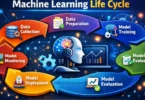
Machine Learning works by teaching computers to learn from data and make predictions. Here is a simple step-by-step explanation for beginners:
- Collecting Data: Data is the first and most important part of ML. Computers need examples to learn from.
- Cleaning & Preparing Data: Data often has mistakes or missing information. Cleaning means removing errors and filling missing values.
- Choosing the Right Algorithm: An algorithm is the method the computer will use to learn from data. Different algorithms are used for different problems.
- Training the Model: Training means letting the computer learn patterns from data. The algorithm looks at features and labels to understand relationships.
- Testing & Evaluating Accuracy: After training, the model is tested on new data it hasn’t seen before. This shows how well it can make predictions.
- Using the Model in Real Life: Once trained and tested, the model can be used to make decisions or predictions automatically.
- Improving the Model: Models can always be improved with more data or better algorithms. Regular updates make the model more accurate over time.
By following these steps, beginners can understand how Machine Learning turns raw data into smart predictions and real-world solutions.
Popular Machine Learning Algorithms for Beginners
Here are some popular Machine Learning algorithms that beginners can start with:
- Linear Regression: Predicts continuous values like house prices.
- Logistic Regression: Used for classification problems like spam detection.
- Decision Trees: Simple model that splits data into decision-based branches.
- K-Nearest Neighbors (KNN): Classifies data based on closest neighbors.
- K-Means Clustering: Groups similar data points without labels.
- Naive Bayes: Fast algorithm for text classification like emails.
- Random Forest: Combination of multiple decision trees for better predictions.
These algorithms are easy to understand and form the foundation for beginners to start practical Machine Learning projects.
Tools and Software to Start Learning ML
To start learning Machine Learning, beginners need the right tools and software. These make it easier to practice, experiment, and build models without complicated setups. Here are some popular and beginner-friendly tools:
- Python: Python is the most popular programming language for ML. Easy to read and simple for beginners. Has many ML libraries like scikit-learn, TensorFlow, and PyTorch.
- Jupyter Notebook: An interactive tool to write and run Python code step by step. Lets you combine code, visuals, and notes in one place. Perfect for experimenting and learning ML concepts.
- Google Colab: Free online platform for writing Python code. Works in your browser, no installation needed. Provides free access to powerful computers for ML projects.
- R Programming: Another language used for data analysis and ML. Simple for statistics-heavy ML problems. Good for visualization and exploring datasets.
- Visual Studio Code (VS Code): A code editor to write Python, R, or other languages. Offers extensions for ML and data science projects. Useful for organizing larger projects and files.
- ML Libraries and Frameworks
- scikit-learn: Simple and beginner-friendly for classic ML algorithms.
- TensorFlow & Keras: For deep learning and neural networks.
- PyTorch: Another popular library for deep learning projects.
Using these tools, beginners can easily start learning Machine Learning, practice coding, and build small projects to gain hands-on experience. The right software makes learning faster, easier, and more fun.
Common Mistakes Beginners Make
When starting with Machine Learning, beginners often make some common mistakes. Knowing these mistakes can help you learn faster and avoid frustration.
- Not Understanding the Data Properly: Many beginners start coding without exploring the data first.
- Choosing Complex Algorithms Too Soon: Beginners sometimes try advanced algorithms without understanding basics.
- Ignoring Model Evaluation: Not testing or evaluating the model leads to poor predictions.
- Overfitting or Underfitting the Model: The model works perfectly on training data but fails on new data.
- Neglecting Continuous Learning: ML is a growing field; beginners may stop learning after initial projects.
- Ignoring Data Preprocessing: Many beginners skip cleaning, normalizing, or transforming data.
By avoiding these mistakes, beginners can build stronger Machine Learning skills, create better models, and enjoy the learning process without unnecessary frustration.
Quick Tips to Get Started with Machine Learning
Starting with Machine Learning can feel overwhelming for beginners, but with the right approach, it becomes much easier. Here are some quick and helpful tips:
- Start Small
- Focus on Understanding Concepts
- Practice Regularly
- Use Beginner-Friendly Tools
- Explore Online Resources
- Experiment and Learn from Mistakes
- Document Your Work
- Join ML Communities
By following these tips, beginners can start their Machine Learning journey with confidence, practice effectively, and gradually build strong skills for real-world applications.
Common FAQs About Introduction to Machine Learning for Beginners
Here are answers to the most common questions beginners have about Machine Learning to help you start quickly.
What is the difference between Artificial Intelligence and Machine Learning?
AI is the broader concept of machines being smart, while ML is a way for machines to learn from data and improve automatically.
Do I need to be good at math to learn Machine Learning?
Basic math like algebra and statistics is helpful, but beginners can start with simple examples and gradually learn more advanced math.
Can I learn Machine Learning without coding?
Yes, there are beginner-friendly platforms like Google Teachable Machine and Orange ML that allow learning ML concepts without coding.
How much time does it take to learn Machine Learning?
It depends on your practice. Beginners can understand basics in a few weeks, but mastering ML may take months with regular practice.
Is Machine Learning only for programmers?
No, even people without programming experience can learn basic ML using visual tools and pre-built datasets.
How do I choose which algorithm to use?
Start simple. Use regression for numbers, classification for categories, and clustering for grouping data. Experiment and learn gradually.
Do I need expensive software or computers for learning ML?
Not really. Free tools like Google Colab provide powerful computing for beginners without buying expensive hardware.
Can I apply Machine Learning in everyday life?
Absolutely! Beginners can use ML in simple tasks like predicting personal expenses, organizing photos, or recommending books or movies.
Conclusion
Machine Learning is a powerful technology that helps computers learn from data and make smart decisions. For beginners, understanding the key concepts, types, algorithms, and real-life applications makes it easier to start. By practicing with simple projects, using beginner-friendly tools, and avoiding common mistakes, anyone can gradually build strong ML skills. With patience and continuous learning, beginners can confidently explore the exciting world of Machine Learning and apply it in everyday life.
Written By: Deepseekplay